Maximizing a 1.2 MW Industrial Microgrid: 7-Day Predictive Modeling That Eliminated Peak Demand Penalties

Client Profile: A heavy manufacturing facility operating a 1.2 MW rooftop and ground-mount solar array designed to offset expensive grid reliance and peak demand charges.

The Challenge

The manufacturer heavily relied on their 1.2 MW onsite solar array to power energy-intensive production lines and avoid crippling peak demand penalties from the local utility. However, facility managers were operating blindly. Sudden weather shifts or silent hardware failures - such as a tripped breaker on a rooftop string inverter - caused unexpected drops in solar generation. Without the ability to accurately forecast solar yield or instantly diagnose hardware faults, the plant frequently ran heavy machinery during generation dips, resulting in massive, unbudgeted grid power costs. The client needed advanced forecasting and fleet-wide diagnostics, but installing and maintaining heavy edge IT infrastructure on the factory roof was out of the question.

The Solution

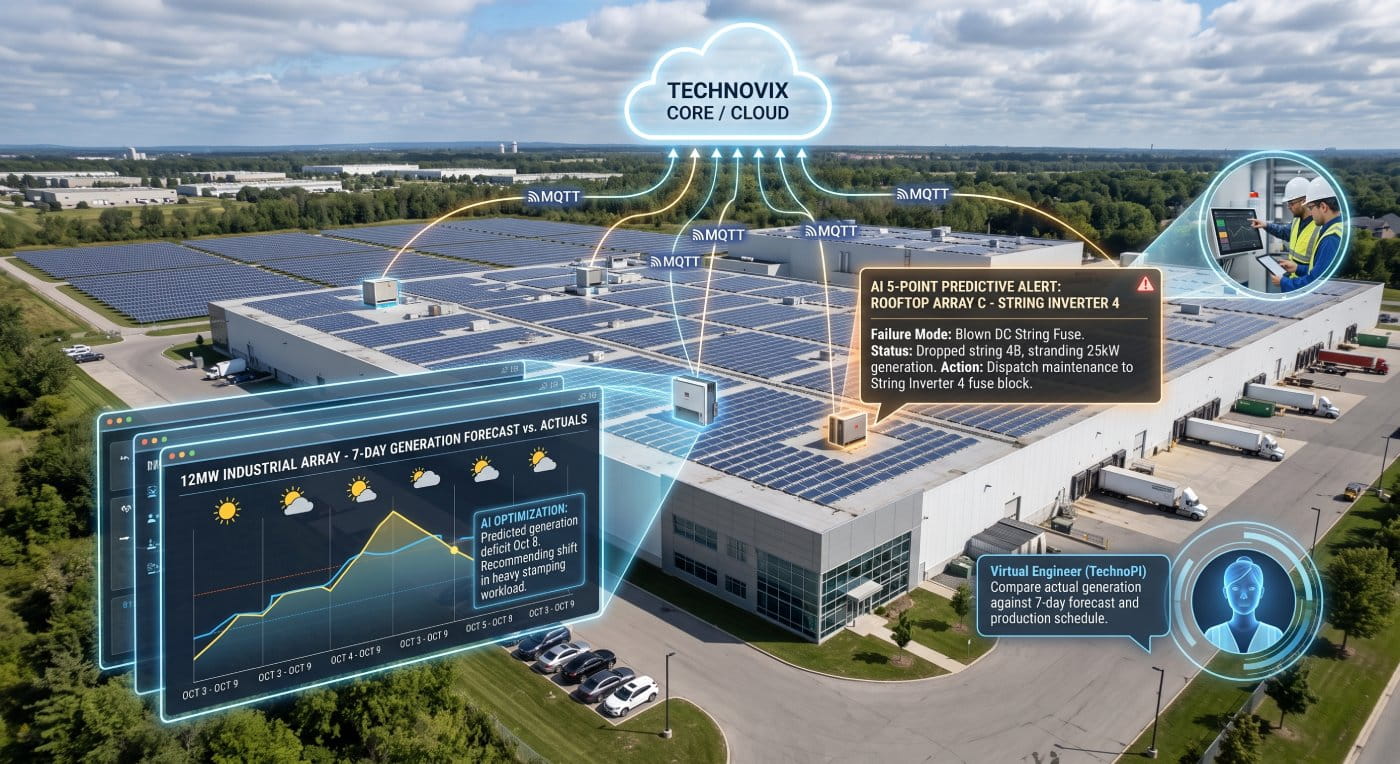
Technovix bypassed local server requirements entirely by deploying a direct-to-cloud architecture. Utilizing the facility’s existing dataloggers, we streamed lightweight MQTT payloads securely into Technovix Core.

Once the data was centralized, our Data Science team deployed the Predictive Modeling service. By correlating the array’s historical telemetry with localized, high-resolution meteorological data, Technovix created a custom machine learning model capable of forecasting solar array production 7 days in advance with 94% accuracy.

To utilize this data, the Facility Manager simply asked the Virtual Engineer (TechnoPI): “Compare our 7-day solar generation forecast against next week’s heavy stamping production schedule.” The AI instantly identified a major deficit expected on Thursday due to heavy cloud cover, allowing the plant to proactively shift the energy-intensive stamping shift to Wednesday’s peak solar window.

Simultaneously, the AI Diagnostic Intelligence Engine actively protected this forecasted yield. When actual generation suddenly deviated from the predictive model on Array C, the cloud engine instantly pushed a structured 5-Point Predictive Alert to the maintenance team:

Severity: High Priority (Generation Deficit)

Component: Rooftop Array C - String Inverter 4

Failure Mode: Blown DC String Fuse

Recommendation: Dispatch an electrician to replace the DC fuse on String 4B.

Summary: Local irradiance matches the 7-day forecast, but Inverter 4 is producing 20% below baseline. The electrical signature confirms a dropped DC string, stranding 25 kW of active generation.

The Impact

  • $44,000 in Avoided Demand Penalties: The 7-day predictive solar modeling allowed the facility to actively align their heaviest manufacturing schedules with peak solar windows, drastically reducing their reliance on expensive grid power.
  • Eliminated Stranded Generation: The 5-point predictive alerts caught silent hardware faults (like blown fuses and thermal derating) that previously went unnoticed for weeks, ensuring the array actually produced what the AI modeled.
  • Rapid, CapEx-Free Deployment: By utilizing MQTT gateways that streamed directly to the cloud, the entire 1.2 MW system was integrated into Technovix Core in days, requiring zero expensive edge servers or complex on-premise IT maintenance.
  • Conversational Energy Management: The Virtual Engineer transformed complex predictive modeling into plain-English answers, allowing non-technical plant managers to confidently shift production schedules based on highly accurate solar data.

“Before Technovix, we were just crossing our fingers that the sun would shine when we ran our heavy lines. Now, the 7-day predictive modeling tells us exactly how much power we will have next week, and the Virtual Engineer makes it incredibly easy to plan our shifts around it. If a panel string drops off, the AI alert tells us exactly which fuse to replace before we even notice a dip on the utility bill.”

Director of Facilities & Sustainability
Slashing HVAC Energy Waste by 20%: Autonomous Climate Control for Precision Manufacturing

Client Profile: A Tier-1 automotive components manufacturer operating a 25,000 sq. ft. facility with heavy CNC machining and strict environmental control requirements.

The Challenge

The facility’s large-scale HVAC infrastructure was managed by a legacy Building Management System (BMS) running on static, time-based schedules. This rigid approach could not adapt to dynamic daily variables like fluctuating ambient temperatures, shifting machine heat loads across different production zones, or variable human occupancy. As a result, the plant was suffering from massive “ghost conditioning” - cooling entirely unoccupied zones and running primary chillers at full capacity during partial-load shifts. Beyond the exorbitant energy waste and punishing peak demand charges, the resulting temperature swings were causing thermal expansion issues in sensitive CNC equipment, directly impacting part tolerances and increasing scrap rates.

The Solution

Technovix transformed the facility’s rigid BMS into an adaptive, AI-driven energy network without a costly rip-and-replace of their heavy mechanical infrastructure. We deployed industrial Edge gateways equipped with multi-protocol translation (BACnet/Modbus) to bridge the legacy controllers with an array of newly retrofitted wireless environmental sensors.

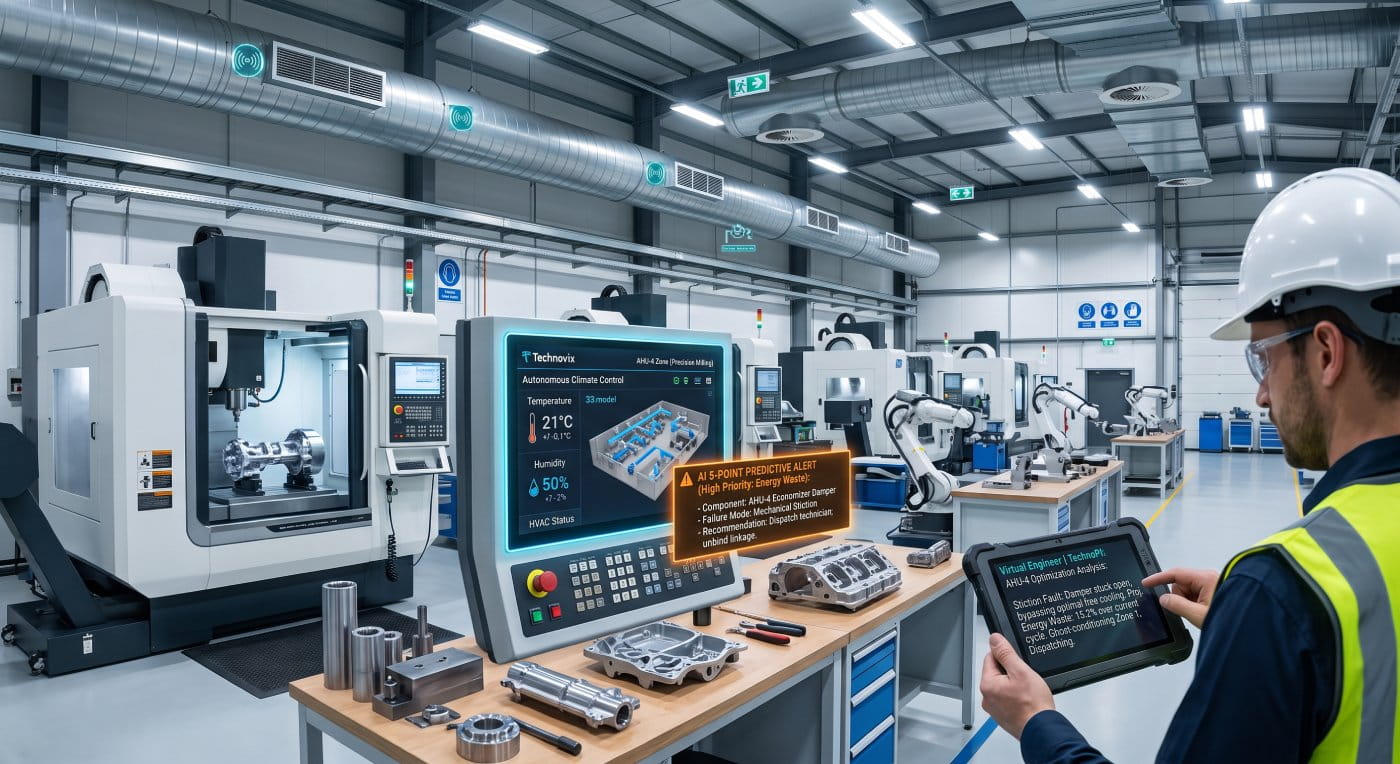
The AI Diagnostic Intelligence Engine began continuously mapping the correlation between localized production heat loads and HVAC energy consumption. Instead of merely adjusting setpoints, the AI actively hunted for mechanical inefficiencies driving up energy costs. During the second week of deployment, it pushed a structured Predictive Alert to the facility manager’s phone:

Severity: High Priority (Energy Waste)

Component: Air Handling Unit (AHU) 4 - Economizer Damper

Failure Mode: Mechanical Stiction / Actuator Failure

Recommendation: Dispatch technician to manually unbind the damper linkage; recalibrate the actuator.

Summary: AHU-4 is failing to utilize free cooling despite optimal 12°C outside air, forcing Chiller 1 to run at 80% load unnecessarily.

Simultaneously, when the Plant Engineer needed to verify the month’s energy performance, they bypassed the complex BMS dashboard entirely and asked the Virtual Engineer (TechnoPI): “Compare yesterday’s peak demand kW against our historical Tuesday baseline for Zone 2.” The AI instantly generated a correlated impact report proving the active savings.

The Impact

  • 20% Reduction in Energy Expenditure: By eliminating rigid scheduling and stopping ghost conditioning, the facility cut facility-wide HVAC energy costs by one-fifth within the first quarter.
  • Targeted Incident Response: The predictive alerts caught failing dampers, fouled coils, and stuck valves before they could artificially inflate the monthly utility bill, shifting maintenance from reactive to proactive.
  • Zero Thermal Scrap: The Virtual Engineer maintained precise, dynamically tailored working conditions around the clock, completely eliminating CNC part variance caused by ambient temperature swings.

“We knew we were wasting energy, but we didn’t have the manpower to manually adjust the BMS every time a production line spun up or down. Technovix didn’t just give us a dashboard; the AI actively controls the environment to save us money, and the diagnostic alerts tell us exactly which mechanical faults are quietly driving up our utility bill. It paid for itself in months.”

Director of Facilities & Energy Management

Preventing Hazardous Spills: Centralized AI Diagnostics for Multi-Site Chemical Transfer

Client Profile: A regional bulk chemical distributor managing multiple remote tank farms, rail-car offloading stations, and transfer terminals.

The Challenge

Managing distributed chemical storage facilities presents a massive visibility problem. The client’s legacy PLCs and transfer pumps were completely siloed at each remote site. Without centralized monitoring, regional managers relied on localized, reactive alarms. If a high-volume transfer pump began to cavitate or suffer a mechanical seal degradation, operators often did not know until a hazardous leak occurred. These failures resulted in stalled logistics, expensive EPA reporting, and dangerous environmental cleanup. The client needed a fast, scalable way to aggregate data across all sites into a single intelligence hub, but installing heavy, expensive edge computing servers at every small remote terminal was financially unviable.

The Solution

Technovix bypassed the need for heavy local infrastructure by deploying our direct-to-cloud architecture. We installed lightweight, plug-and-play gateways at each remote tank farm. These gateways instantly translated legacy Modbus and OPC UA data into secure, lightweight MQTT payloads, streaming high-frequency data directly to Technovix Core via cellular and standard internet connections.

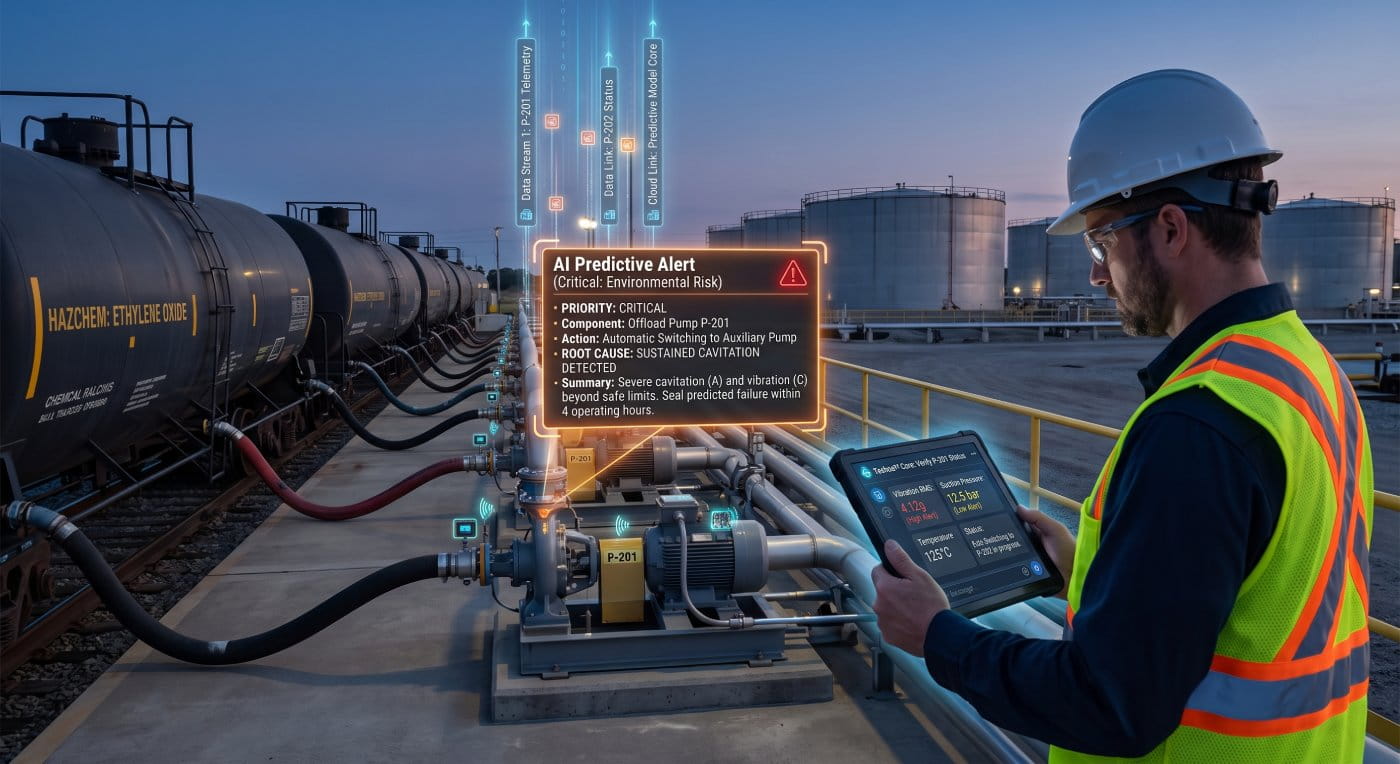
With all multi-site data flowing into the centralized cloud, the AI Diagnostic Intelligence Engine continuously analyzed fleet-wide baselines. During a routine rail-car offload at Terminal B, the cloud engine detected a microscopic anomaly and instantly pushed a structured 5-Point Predictive Alert to the regional maintenance director’s mobile device:

Severity: High Priority (Environmental Risk)

Component: Terminal B - Offload Pump P-201

Failure Mode: Impending Mechanical Seal Failure

Recommendation: Abort transfer on P-201; automatically switch to auxiliary pump P-202.

Summary: Sustained cavitation signature (high vibration + micro-pressure drops) detected. Seal integrity is compromised and will fail within 4 operating hours.

To understand if this was an isolated incident or a fleet-wide issue, the director logged into the Technovix Core dashboard and asked the Virtual Engineer (TechnoPI): “Compare the vibration signatures and seal degradation rates of all P-200 series pumps across Terminals A, B, and C over the last 90 days.” The cloud-based AI instantly processed millions of historical data points, generating a fleet-wide health report that revealed pumps handling a specific high-viscosity solvent were degrading 40% faster than the rest of the fleet.

The Impact

  • Zero Hazardous Leaks: The predictive 5-point alert allowed the team to halt a failing pump before a mechanical seal ruptured, entirely preventing a hazardous chemical spill and regulatory fines.
  • Rapid, Low-CapEx Scalability: By utilizing lightweight MQTT gateways that communicate directly to the cloud, Technovix deployed the solution across multiple remote terminals in a matter of days, with zero requirement for expensive local server infrastructure.
  • Centralized Fleet Intelligence: The Virtual Engineer acted as an on-demand data scientist, allowing leadership to instantly cross-reference asset health across geographically separated facilities from a single prompt.
  • Optimized Maintenance Procurement: The cloud analytics proved that specific chemical viscosities were destroying pump seals prematurely, allowing the client to upgrade to specialized mechanical seals for those exact tanks, drastically extending asset lifespans.

“We used to operate completely blind across our remote terminals. By streaming everything directly to Technovix Core, we suddenly had a unified view of our entire regional fleet. The AI alerts stop leaks before a single drop hits the ground, and being able to ask the Virtual Engineer to compare pump health across three different cities in seconds is an absolute game-changer for our logistics.”

Regional Director of Operations

Preventing $85,000 in Batch Spoilage: How Predictive AI Transformed a Custom Food Co-Packer’s Floor

Client Profile: A large-scale North American custom food and beverage co-packer running multiple high-volume mixing, pasteurization, and chilling lines.

The Challenge

The facility struggled with unpredictable mechanical failures in their primary chilling loops. When a compressor stalled or a cooling valve stuck during a critical exothermic mixing phase, it resulted in immediate batch quarantines and massive scrap costs. Maintenance and QA teams were drowning in raw SCADA alarms, forcing them to manually cross-reference PID loop data, flow rates, and temperature data across multiple screens to piece together a root cause. This manual investigation extended Mean Time to Repair (MTTR) to unacceptable levels, often resulting in entire production runs going down the drain before the physical fault could be identified.

The Solution

Technovix modernized the facility’s monitoring strategy through our Gateway-as-a-Service (GaaS) model, unifying their legacy PLCs and standalone sensors into the Technovix Core and Edge architecture with zero operational disruption.

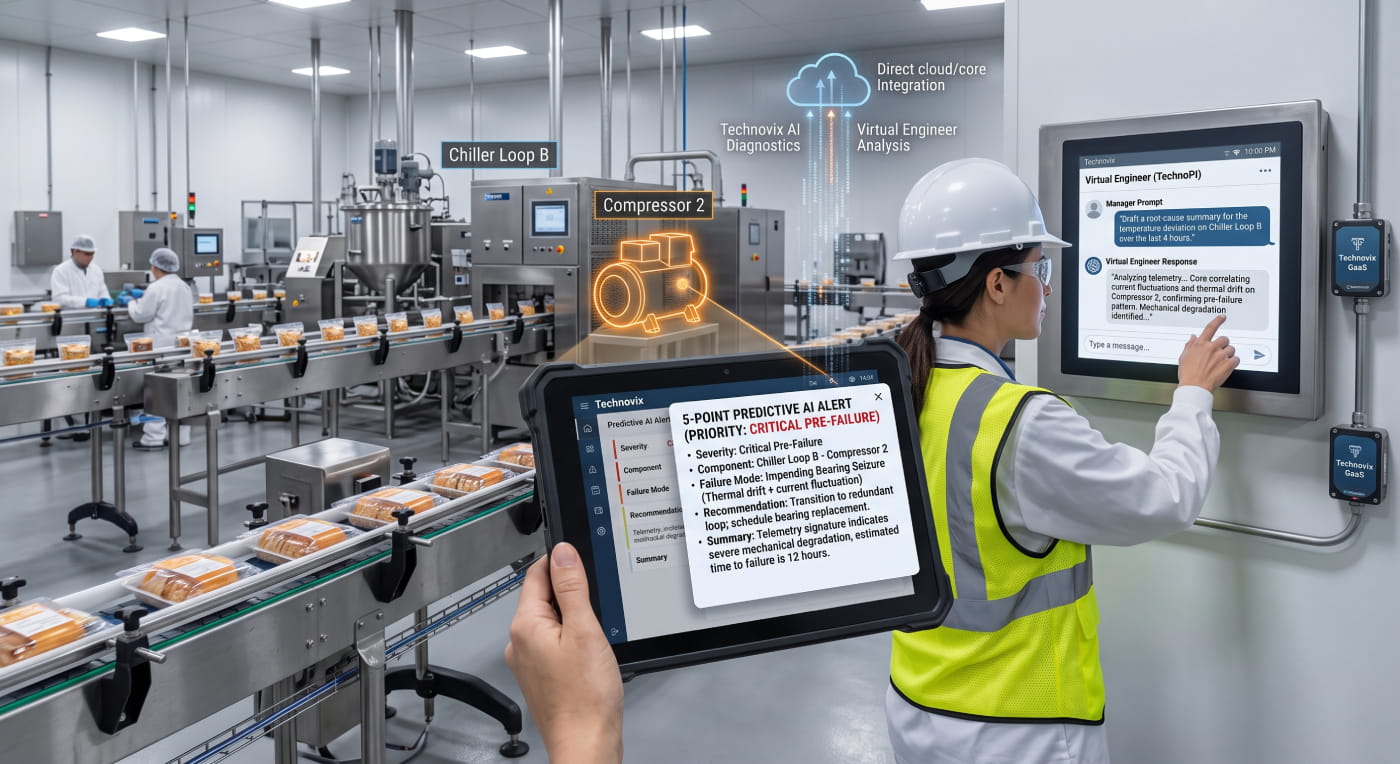
Instead of relying on standard high/low threshold alarms, the AI Diagnostic Intelligence Engine began mapping the plant’s complex thermal and mechanical baselines. During a high-value production run, the system detected a subtle divergence: a slow thermal drift on Chiller Loop B coupled with an erratic current draw.

Hours before a catastrophic breakdown occurred, the platform bypassed traditional SCADA noise and pushed a structured 5-Point Predictive Alert directly to the maintenance team’s Microsoft Teams channel:

Severity: Critical Pre-Failure

Component: Chiller Loop B - Compressor 2

Failure Mode: Impending Bearing Seizure (thermal drift + current fluctuation)

Recommendation: Transition to redundant loop; schedule bearing replacement.

Summary: Data indicates severe mechanical degradation; estimated time to failure is 12 hours.

To validate the impact on production, the Plant Manager opened the Virtual Engineer (TechnoPI) terminal. By simply asking, “Draft a root-cause summary for the temperature deviation on Chiller Loop B over the last 4 hours,” the AI instantly correlated the mechanical degradation with the process data. It confirmed the exact moment the cooling capacity dropped and generated a precise, audit-ready compliance report for the QA team.

The Impact

  • Zero Batch Loss: The predictive alert allowed operators to seamlessly transition to a redundant cooling loop during a scheduled sanitation shift, directly preventing the loss of an $85,000 custom formulation batch.
  • 80% Reduction in MTTR: The 5-point AI alert eliminated hours of diagnostic guesswork. Technicians arrived at the compressor with the exact right replacement parts in hand before the machine actually failed.
  • Instant Audit Compliance: The Virtual Engineer reduced a tedious 3-hour manual QA reporting process into a 15-second conversational query, generating an instantly exportable CAPA (Corrective and Preventive Action) draft.
  • Zero Upfront CapEx: Executed entirely under the Technovix GaaS model, allowing the facility to achieve predictive reliability without waiting for annual capital expenditure approvals.

“We used to react to alarms while the product was already going down the drain. The 5-point AI alerts tell us exactly what is about to break, and being able to just ask the Virtual Engineer for a root-cause report feels like having a senior reliability expert on shift 24/7.”

Director of Plant Operations